Camera Basics
 Camera Choosing
 Camera Models
 Camera Buying
 DSLR Buying

Canon Powershot SX100 IS Review
 8 Megapixels
 Ultra-Zoom: At least 10X optical zoom.
 Stabilization: Compensates for tiny involuntary movements of the camera.
 VGA Video: 640 x 480 or more but less than 1280 x 720.
 Manual Controls: Both fully-manual (M) and semi-automatic modes (T and V).
 Custom White-Balance: Specifies exactly what should be white to the camera.
 Action Photography: Shutter speeds of 1/1500 or more.
 Night Photography: Reaches shutter-speeds longer than 4 seconds.
 Spot Metering
 Runs on standard AA batteries
 Accepts Secure Digital High Capacity (SDHC) and SD memory.
 Neocamera detailed review
 Discontinued: No longer produced by the manufacturer. May still be in stock or found used.
Canon Powershot SX100 IS Introduction
The Canon Powershot SX100 IS packs an impressive feature set that includes a wide range of ISO, full-manual controls, manual focus, custom white-balance, exposure lock, choice of metering patterns and use of standard AA batteries. Among, compact ultra-zoom cameras, this is the only one with all these features. More features of this digital camera include a VGA movie mode, macro (1cm) & face-detect focus, built-in flash with red-eye reduction and slow-sync, single & continuous AF and multiple self-timers.
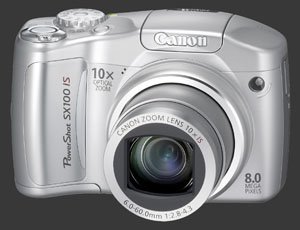
The Canon SX100 is the first compact ultra-zoom digital camera from Canon. With a 10X stabilized optical zoom lens in a body that is less than 2" thick, this digital camera has an appealing form-factor that is shared with very few other cameras.
| Key Features |
|---|
| 8 Megapixels sensor |
| 10X Optical zoom lens with optical image stabilization equivalent to 36-360mm, F2.8/4.3-F8 |
| ISO Sensitivity from 80 to 1600 |
| Shutter-speeds from 1/2500s to 15s |
| Program, Aperture-Priority, Shutter-Priority and Manual exposure modes |
| Automatic white-balance, 5 white-balance presetsDaylight, Cloudy, Tungsten, Fluorescent, Fluorescent High and custom white-balance |
| Evaluative, center-weighed and spot metering |
| Normal, Macro and Manual focus |
| Auto-exposure-lock (AEL) |
| Exposure compensation, -2..+2 EV, 1/3 EV steps |
| Flash compensation, -2..+2 EV, 1/3 EV steps |
| Manual flash control, 3 levels |
| Customizable self-timer with 2s and 10s presets |
| 640x480 30 FPS Movie mode |
Canon Powershot SX100 IS Suitability - What is it good for?
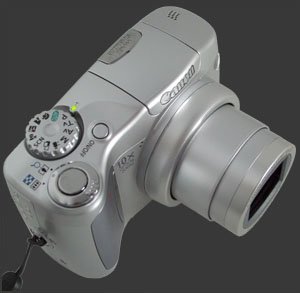
With its standard 36-360mm zoom range and full manual-controls, the Canon Powershot SX100 is suitable for general photography with a preference for far away and macro subjects rather than large and close by ones like architecture and indoor scenery. Although both night and action photography are possible given the shutter-speed and ISO ranges available, performance will be the limiting factor at both extremes.
Canon Powershot SX100 IS Usability - How easy is it to use?
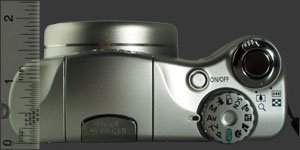
Ergonomically, the SX100 has a design which combines a smooth and comfortable hand-grip with enough space to rest the thumb against the camera's back. Buttons and dials are all easily accessible with little shift from the standard two-handed holding position. There are dedicated buttons for image playback and exposure compensation. While both these buttons are easy to activate, it would make much more sense if their positions were swapped so that exposure-compensation would be easier to reach while shooting.
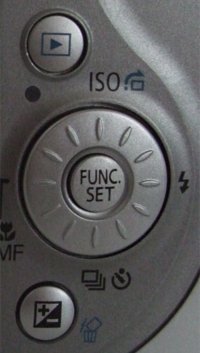
The 4-way controller, which also rotates, gives direct access to ISO, focus, flash and drive modes. The rotating aspect is extremely useful while in manual or semi-automatic modes, plus it also allows faster menu navigation. The problem with this combined 4-way and rotating-wheel controller is that is very easy to accidentally activate the feature which you are not trying to use. During our review period, it frequently happened to activate one of the 4-way options while rotating the dial to change aperture or shutter-speeds.
The camera's 2.5" LCD features 172K pixels which make it quite sharp. Visibility is average in bright light with a good refresh rate. Under low light, the LCD gains up very well, although the refresh rate takes a dip. There are 4 buttons located below the LCD. This placement is very good because, when holding the camera with two hands, the left thumb can reach them quite comfortably. One of these buttons, labeled with the direct-print icon, is actually customizable, thus making it immensely more useful than its default purpose.

The Canon Powershot SX100 IS's sleek curves reveal a modern elegance and a feeling that there is something missing from this digital camera. Indeed, neither a viewfinder nor a flash disrupts the SX100's smooth design. A relatively weak flash is actually hidden behind the silver Canon logo. This does have two advantages. One, keeping the flash closed automatically ensures that it will never fire. Two, raising the flash gives it a greater distance from the lens which reduces the probability of red-eye and lens obstruction. As for a viewfinder, the Canon SX100 does not have one. This is clearly a compromise aimed at keeping this ultra-zoom compact and affordable: a EVF would add cost and bulk to the camera, while an optical tunnel would be impractical for such a zoom range.
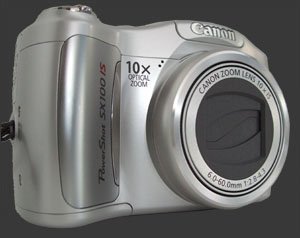
Canon Powershot SX100 IS Performance - How well does it take pictures?
The type of camera that combines a powerful zoom and a compact body must, apparently, compromise on image quality to a certain point. The image quality of the SX100 represents this compromise with both strong and weak points. Overall, image quality is reasonable but far from top-notch, specially compared to the Canon A-series of compact cameras which sport 3X to 6X zoom lenses.

Exposure is good and highly consistent. This digital camera produces bright results in most situations and requires less positive exposure compensation than most when faced with bright scenes. This is ideal for direct printing but occasionally clips highlights.
Colors from the Canon SX100 are generally accurate and well saturated without appearing over-saturated. White-balance is not perfect, but clearly better than average. Even automatic white-balance handled incandescent light sources better than most digital cameras. A slight bluish color-cast was noticed for snow-covered landscape under overcast sky.
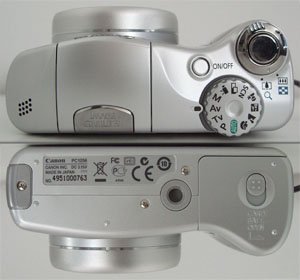
Image noise is clearly this digital camera's weak point. At all ISO settings, even the lowest, noise is evident and definitely above average. This high noise causes a very noticeable loss of fine details in most images. ISO 80 to 200 are quite usable under most conditions but noise creeps up fast starting at ISO 400. By ISO 800, only the smallest print sizes can be recommended. The ISO 1600 setting produces useless results.
The big selling point of the Canon Powershot SX100 IS, its compact 10X zoom lens, is quite an achievement. Sharpness is solid with rather good edge-to-edge consistency. In our evaluation unit, there was softness only in the upper-left corner which may be a quality control problem since we have not seen this in images from other SX100 reviews.
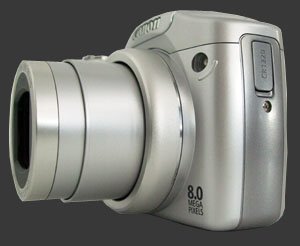
Optical distortion are quite low for such a zoom range. At the normal focus range, a slight barrel distortion is visible at wide-angle. Similarly to most lens, this increases in macro mode. Chromatic aberrations are a bit higher than average but nothing terrible. The built in stabilization seems quite effective.
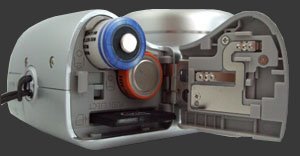
The SX100 holds its own well when it comes to speed. All controls are responsive, there is very little shutter-lag and shot-to-shot speed is quite good. Focusing is speedy in bright light and slower-but-decent in low light. The playback mode is extremely fast with nearly instant zooming and image browsing (except when using the rotating dial which purposefully slows down browsing to shot a useless animation). Startup and shutdown are average. The only slow aspects of the Canon SX100 are the continuous-drive and flash recycling time. This compact camera also performs very well in terms of battery-life using only 2 standard AA batteries.
Canon Powershot SX100 IS Conclusion
Let's get the only serious problem out of the way: The Canon Powershot SX100 IS has a very noisy sensor that destroys details even at low ISO. No doubt about it, this bad for large prints and low-light shooting.
Nearly every other aspect of the SX100 in terms of quality, performance and feature set is impressive. Of the few compact ultra-zoom digital cameras around, this is the most feature rich. Having 10X optical zoom with built-in stabilization, full-manual controls, custom white-balance and the convenient use of AA batteries is presently unique.
Keeping this in mind, one must decide if this feature set is worth the high image noise. For the user who shares his images through the web and makes mostly small prints, the SX100 can be very appealing. Those who regularly make medium and large prints should settle for a larger camera.
 |


|

Please Support Neocamera
All information on Neocamera is provided free of charge yet running this website is a huge endeavor. Purchases made via affiliate links found throughout the site help keep it running and up-to-date. There is no additional cost to you, so please consider buying via these links to our affilates:




If you found any information on this site valuable and did not purchase via our affiliate links, please considering donating via PayPal:
Any amount will be greatly appreaciated. Thank you for your support!


Canon SX100 IS Highlights
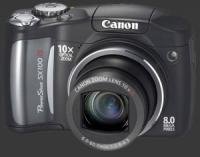


 Compact digital camera
Sensor-Size: 6 x 4mm

Actual size when viewed at 100 DPI
| 8 Megapixels Travel Zoom | ISO 80-1600 |
| 10X Optical Zoom | Shutter 1/2500-15s |
| Built-in Stabilization | Full manual controls |
| 1.3 FPS Drive, Unlimited Images | Custom white-balance |
| 640x480 @ 30 FPS Video Recording | Spot-Metering |
| 2.5" LCD 172K Pixels | Standard AA Battery |
| Secure Digital High Capacity |
Camera Bag


Your camera bag is empty. To add a camera or lens click on the star next to its name.
Your camera bag is empty.
Add cameras or lenses by clicking on the star next to their name.
Updates
2024.04.03

Fujifilm X-T5 Review
Newest Fujifilm flagship boasting a 40 MP APS-C sensor, 5-axis IBIS with 7-stop efficiency, 15 FPS continuous drive, 6.2K Video capture, dual control-dials and dual SDXC UHS-II slots in a sturdy weatherproof and freezeproof body.
2023.11.20

Best Digital Cameras of 2023
Find out which are the Best Digital Cameras of 2023. All the new Mirrorless Digital Cameras from entry-level to high-end professional.
2023.07.10

Fujifilm X-H2 Review
40 Megapixels APS-C Hybrid Mirrorless Digital Camera with 7-stop IBIS. Fastest shutter ever and 8K video capture. Large builtin EVF with 0.8X magnification and 5.8 MP, plus an Eye-Start Sensor. Packed with features and large number of controls in a weatherproof and freezeproof body.
2023.05.07

Sony FE 20-70mm F/4G Review
Review of the unique Sony FE 20-70mm F/4G lens. The optical zoom of this lens spans ultra-wide-angle and medium focal-length coverage, making it one of the most versatile Full-Frame lenses on the market.
2023.01.15

Huion Inspiroy Dial 2 Review
Review of the Huion Inspiroy Dial 2 tablet, a medium sized drawing surface with dual dials and customizable buttons. Connects via USB-C or Bluetooth 5.0 with Windows, Linux and Android support.
2022.12.08

How to Pack for a Photo Trip
Find out how to pack for a travel photography trip, carry your gear safely while meeting airline regulations.
2022.11.13

Best Digital Cameras of 2022
The best digital cameras of 2022. A short list of the most outstanding models in their respective categories. Choose one for yourself or as a gift.
2022.09.21

Pentax DA* 60-250mm F/4 SDM Review
Review of the Pentax DA* 60-250mm F/4 SDM, the constant-aperture telephoto zoom with the highest zoom-ratio on the market.
2022.09.20

Pentax DA* 50-135mm F/2.8 SDM Review
Review of the Pentax DA* 50-135mm F/2.8 SDM, the lightest professional telephoto zoom native to the K-mount.
2022.09.10

Pentax DA* 11-18mm F/2.8 DC AW Review
Review of the Pentax DA* 11-18mm F/2.8 DC AW, the widest professional ultra-wide zoom native to the K-mount.
2021.11.24

50 Gifts Under $50 For Photographers in 2021
50 Gifts photographers will love. All for under $50 USD. 2021 Edition.
2021.11.17

Best Digital Cameras for 2021
Neocamera shows which are the very best Digital Cameras for 2021 in every category: Mirrorless, DSLR, Premium Compact, Ultra-Zoom and Rugged.
2024.04.03
2023.11.20
2023.07.10
2023.05.07
2023.01.15
2022.12.08
2022.11.13
2022.09.21
2022.09.20
2022.09.10
2021.11.24
2021.11.17